
Book Introduction
Introduction
A closer look at the book overview
Book Introduction
About This Book
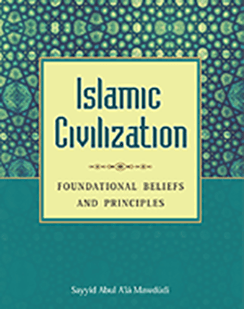
The following is a summary of the foundational concepts presented in the work "Islamic Civilization: Its Foundational Beliefs and Principles." The intellectual landscape of the twentieth century was profoundly shaped by several key figures who sought to bridge the gap between classical scholarship and modern political reality, and among the most prominent of these was the distinguished scholar Syed Abul A'la Maududi رحمۃ اللہ علیہ. Standing as a colossus in the history of Muslim South Asia, he was not merely a scholar confined to the quietude of a library but a "public intellectual" in the truest sense—a visionary who combined rigorous epistemological inquiry with social activism. His work, written against the backdrop of the declining British colonial empire and the rising tide of Muslim political awareness, serves as a critical exploration of what constitutes the essence of a civilization. In his seminal treatise, Maulana Maududi رحمۃ اللہ علیہ addresses a subject of immense historical and philosophical weight: the relationship between a civilization and its underlying worldview, specifically dissecting the roots and nature of Islamic civilization. The context in which Syed Maududi رحمۃ اللہ علیہ penned this work in the early 1930s is vital for understanding its thrust. It was a period when the definition of civilization itself was being debated, with historians like Arnold Toynbee viewing it as a unit of historical inquiry, while others focused on material advancements such as urbanization, statecraft, and record-keeping. However, Maulana Maududi رحمۃ اللہ علیہ moves beyond the superficial markers of civilization—such as the development of fine arts, complex political institutions, or the rise of cosmopolitan cities. While acknowledging that these elements denote an ordered society that has moved beyond primitive existence, he argues that they are merely the external manifestations of a deeper internal reality. To understand a civilization, one must look past the leaves and the fruit of the tree and examine the roots; one must understand the soul that animates the body of society. A central theme of the text is a rigorous refutation of a prevalent academic bias found among Western scholars of the time. These historians often posited that Islamic civilization was not an original entity but rather a continuation or an outgrowth of preceding cultures, particularly the Greek, Roman, and Persian civilizations. The argument often made was that the Arabs simply adopted the building blocks of these ancient societies and, through a specific cultural mindset, rearranged them to create a slightly modified structure without altering the fundamental content. Syed Abul A'la Maududi رحمۃ اللہ علیہ categorically rejects this perspective, dismantling the idea that Islamic civilization is a patchwork of borrowed cultures. While he admits that human progress is cumulative and that every generation utilizes the materials of the past, he draws a sharp distinction between the raw materials of construction and the architectural design itself. To illustrate this, Syed Maududi رحمۃ اللہ علیہ employs the metaphor of a building. He argues that while the bricks and mortar may be sourced from the earth or previous structures, the essence of the building lies in its architectural plan, its intended purpose, and the specific vision of its builders. The paint, the façade, and the furniture are superficial; the foundation and the design are essential. Similarly, while Islamic civilization may have interacted with the material advancements of the past, its core—its distinct architectural blueprint—is purely Islamic. It is not a Roman or Persian building with an Arab façade; it is a unique edifice constructed upon an entirely new set of foundational principles. The source of this civilization is not historical borrowing but a distinct revelation and a unique worldview. This brings the discourse to the fundamental inquiries that lie at the heart of the work produced by Maulana Maududi رحمۃ اللہ علیہ. He posits that the true measure of a civilization is found in how it answers the perennial questions of human existence. Every culture, consciously or unconsciously, is built upon a specific set of answers to these ultimate questions: Is the universe a result of random chance, or is it the creation of an All-Wise Creator? If there is a Creator, what is the nature of the relationship between the Divine and the human? What is the purpose of human life? Is death the absolute end, or is there an existence beyond the physical realm? Syed Abul A'la Maududi رحمۃ اللہ علیہ asserts that a society’s responses to these questions determine its direction, its morality, and its ultimate destiny. If a civilization evades these questions, its progress is akin to wandering aimlessly in circles; it may generate frenzied activity, but it lacks true direction. The distinctiveness of Islamic civilization, as elucidated by Syed Maududi رحمۃ اللہ علیہ, stems from the clarity and cohesion with which it answers these inquiries. Islam provides a worldview that is organically interrelated and rational. The belief in the One True God, the role of the Prophets, the reality of the Angels, the guidance of the Revealed Books, and the certainty of the Last Day are not disparate dogmas but are woven together to form a comprehensive vision of life. This system of belief appeals to human reason and aligns with the innate nature of humanity. It is a worldview that validates the human urge to satisfy biological needs and pursue success, yet it prevents society from falling into the extremes of Epicureanism, where the pursuit of pleasure becomes the sole objective of existence. Maulana Maududi رحمۃ اللہ علیہ emphasizes that the Islamic way of life is a "middle path." It acknowledges the material world but subordinates it to a higher moral and spiritual purpose. This worldview acts as the root system; the culture, the legal systems, the social etiquette, and the arts are the natural outgrowth of these roots. Therefore, to appreciate the "venture of Islam" in history, one cannot merely study its artifacts or political history; one must grasp the constitutive concepts of its worldview. The civilization is the physical operationalization of the theological premise that there is no deity except God. Furthermore, the approach taken by Syed Abul A'la Maududi رحمۃ اللہ علیہ in this work highlights a critical methodological priority: "first things first." Before one can discuss the details of the Islamic social order, the penal code, or the political structure, one must understand the ABCs of the faith. The structure of Islamic life is built upon the foundation of Iman (belief). Attempting to establish or understand the Islamic order without a firm grasp of its doctrinal foundations is a futile exercise. The author argues that the strength of the civilization correlates directly with the clarity and strength of these foundational beliefs. The text also highlights that the uniqueness of this civilization lies in its independence from geographical or racial origins. Unlike the "Arab mindset" theory proposed by Orientalists, Syed Maududi رحمۃ اللہ علیہ posits that the civilization is defined by principles that transcend ethnicity. It is a civilization of ideas, not of soil. When the foundational beliefs are accepted, they transform the psyche of the individual and the collective, creating a society that possesses a specific moral flavor and a distinct direction. The refusal to accept the validity of the "borrowed civilization" theory is crucial because accepting it would imply that Islam has no intrinsic worldview of its own, but rather a derivative one. By asserting the originality of the Islamic design, Maulana Maududi رحمۃ اللہ علیہ restores the agency and intellectual independence of the Muslim historical narrative. In his analysis, Syed Abul A'la Maududi رحمۃ اللہ علیہ also touches upon the relationship between the material and the ethical. A civilization that is highly developed materially but ethically bankrupt is, in the Islamic view, a failed project. The integration of moral conduct with material development is a hallmark of the Islamic approach. The record-keeping, the city-building, and the scientific advancements are all valid components of civilization, but in the Islamic context, they must be governed by the overarching law of God. This ensures that the society remains "ordered" not just in a political sense, as Hobbes might describe, but in a moral sense, where life is preserved, dignified, and purposeful. Ultimately, the summary of this work reveals a profound intellectual effort to decolonize the history of Islamic civilization. Syed Maududi رحمۃ اللہ علیہ provides a framework that allows Muslims to view their heritage not as a historical accident or a modification of Western antiquity, but as a deliberate, divinely guided construction. He challenges the reader to look beneath the surface of history and recognize that the true power of a civilization lies in its ideas. By focusing on the "roots" rather than the "foliage," Maulana Maududi رحمۃ اللہ علیہ offers a timeless insight: that the revival or understanding of Islamic civilization is impossible without a return to the foundational beliefs that sparked its genesis. It is a call to recognize that while the bricks may be universal, the blueprint of Islam is divinely unique, and it is this blueprint that gives the civilization its enduring validity and distinct identity.