
Book Introduction
Introduction
A closer look at the book overview
Book Introduction
About This Book
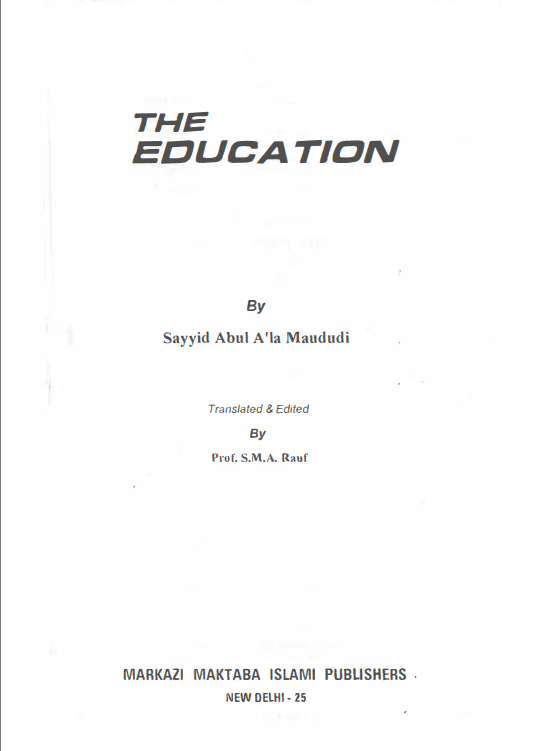
The education of a nation’s youth is the most critical factor in determining its future trajectory, survival, and identity. The fate of any community is irretrievably linked to the upbringing of its younger generation, for they are the ones who will eventually assume the helm of leadership. The primary argument presented in this work posits that the physical survival of a people is meaningless if they lose their cultural and ideological soul. If the elders of a nation fail to hand over their cultural heritage to their progeny, the ideological foundation of the country weakens, and while the generation may survive biologically, they cease to maintain a distinct identity. For Muslims specifically, this challenge is profound. Muslims are bound together not merely by geography or race but by a common culture and faith that regulates both individual and communal life. To emerge as a potent force in the world, they must harmonize their temporal and spiritual lives in accordance with the teachings of Islam. However, the historical reality has been one of decline. Centuries of monarchy, colonialism, and autocratic rule have contributed to a severe moral and spiritual degeneration among Muslims globally. To reverse this trend, it is argued that the Muslim Ummah must restructure its educational program entirely. It is not enough to rely on traditional methods or to blindly adopt secular Western models, as both have failed to meet the comprehensive needs of the community. The vision put forth by Syed Abul A'la Maududi رحمۃ اللہ علیہ is one of a holistic educational system that refuses to separate the sacred from the secular. The ultimate goal is to produce a new generation of scholars and professionals—Muslim philosophers, Muslim scientists, Muslim economists, and Muslim jurists—who are experts in their respective fields but whose intellectual foundations are deeply rooted in the tenets of Islam. The critique of the prevailing educational systems is a central theme of the text. As early as the 1930s, there was a growing realization among the Muslim intelligentsia in the subcontinent that modern educational institutions were exercising a pernicious influence on students. Rather than producing devout Muslims capable of navigating the modern world, these institutions were churning out graduates who were increasingly skeptical, atheistic, or enamored with alien ideologies such as communism. Maulana Maududi رحمۃ اللہ علیہ identified that the root cause of this crisis was not merely a lack of religious instruction, but the very structure of the educational system itself. The institutions, particularly Aligarh Muslim University, which was established with the hope of reconciling modern learning with Islamic identity, had failed to achieve their purported goals. The analysis provided by Syed Maududi رحمۃ اللہ علیہ regarding the failure of Aligarh is sharp and uncompromising. The university was founded to allow Muslims to benefit from modern sciences without losing their faith. However, because the founders lacked a clear blueprint for an Islamic university, they merely replicated the structures of existing secular government colleges, such as those in Agra and Lucknow. The result was an institution that was Muslim in name but secular in spirit. The administration and the overall functioning of the university offered no evidence of a distinct Islamic character. Consequently, the graduates leaving these halls were hardly distinguishable from those of secular universities; they were devoid of Islamic character, spirit, and conduct. When complaints about the spread of atheism and irreligiousness became too loud to ignore, the university administration attempted to rectify the situation by forming a committee. The proposed solution was to increase the dosage of theology—Islamiat—in the curriculum. Maulana Maududi رحمۃ اللہ علیہ critiqued this remedial measure as superficial and destined to fail. He argued that the wave of atheism and secularism engulfing the students could not be deterred simply by adding a few religious courses to a curriculum that was otherwise entirely secular in its worldview. The issue was foundational. The entire educational atmosphere, from the teaching of philosophy and science to the social life of the campus, was designed to produce "facsimile Englishmen" or devotees of composite nationalism, rather than true Muslims. The text highlights that this lack of forethought by the founders led to a waste of resources and potential. Millions of rupees were spent to establish a separate university, yet it failed to produce even a negligible minority of students capable of infusing new life into the Muslim Ummah. Instead, a significant number of alumni became de-Islamized, posing a threat to the very culture they were meant to preserve. Syed Abul A'la Maududi رحمۃ اللہ علیہ pointed out that many students moved from apathy toward religion to open antagonism. The intellectual environment was such that skepticism culminated in a denial of the fundamentals of faith. A poignant example of this intellectual drift is illustrated through the experience of a young graduate from the Muslim University. In a personal account referenced in the text, the student describes encountering communism and a firm indifference to Islam during his time at Aligarh. He noted that the westernized atmosphere acted as a gateway to apostasy. Teachers and senior students, who presented themselves as champions of the poor and the peasantry, were actually luring promising new students into the net of communist ideology. Syed Maududi رحمۃ اللہ علیہ used such evidence to demonstrate that the synthesis of Islam and Western secularism, as attempted at Aligarh, was an illusion. The graduate eventually realized that communism and Islam were antithetical, but many others were lost to these alien ideologies because the educational system provided no intellectual defense against them. The relevance of these educational theories extends far beyond the pre-partition era. The text suggests that the educational policy rationalized by Maulana Maududi رحمۃ اللہ علیہ fifty years ago remains valid today. Education is described as a matter of life and death for an ideological state. A state committed to a specific ideology can only survive if its educational program is structured to support that ideology. The tragic secession of East Pakistan in 1971 is cited as a catastrophic example of what happens when this principle is ignored. The rise of Bengali nationalism, which led to the breakup of the country, is attributed to the dominance of secular education that failed to foster a unified Islamic identity. Had the warnings regarding the need for an ideology-based education been heeded, the political unity of the nation might have been preserved. Furthermore, the moral and spiritual decadence visible in contemporary society is directly linked to the baneful impact of secular education. The text notes that there is hardly a department of life immune from corrupting influences. Persons holding the highest public offices resort to corrupt practices, and hypocrisy and selfishness have become hallmarks of the community. Despite Muslims constituting a significant portion of the world's population, they are described as the most humiliated community, lacking a voice in the comity of nations. Syed Abul A'la Maududi رحمۃ اللہ علیہ argued that this powerlessness is a direct result of an education system that acts as an anathema to the Muslim spirit. To regain lost glory, a revolutionary change in the educational system is required, one that is based on a sound Islamic footing rather than the bequeathed legacies of colonial masters. Critics, often described as modernists, may view such an educational program as unrealistic or visionary. However, the text defends the foresight of Syed Maududi رحمۃ اللہ علیہ, noting that farsighted individuals are often decried as myopic by their contemporaries. These critics, blinded by prejudice, fail to appreciate anything that possesses a distinct Islamic character. The persistence of the current secular system guarantees that the community will remain unable to recover from its moral and spiritual decline. The text implies that the refusal to accept these necessary changes is akin to the condition described in the Quran where hearts are sealed and eyes are covered. The overarching message is that a "mixture" of systems is insufficient. Trying to blend a secular curriculum with supplementary religious instruction is a failed experiment. The challenge of modern times calls for reconstructing the entire edifice of education. The goal is not to shun modern knowledge but to integrate it within an Islamic framework so that the resulting knowledge fulfills both spiritual and temporal obligations. The vision of Maulana Maududi رحمۃ اللہ علیہ was to create an educational environment where the physicist, the economist, and the statesman are not torn between their professional knowledge and their faith, but rather see their work as an extension of their submission to the will of Allah. Ultimately, the text serves as both a diagnosis of a deep-seated malaise and a prescription for a cure. It asserts that the rise and fall of nations are determined by the quality of their human resources. For the Muslim nation, survival depends on reclaiming its intellectual independence. As long as the educational program continues along secular lines, the community will remain adrift, physically alive but culturally dead. The writings of Syed Abul A'la Maududi رحمۃ اللہ علیہ contained in this volume are presented not merely as historical documents but as an urgent blueprint for the reconstruction of the social order in accordance with the tenets of Islam. The plea is for the current generation to wake up to the reality that without an education system that is intrinsically Islamic in its structure, aim, and scope, the future generations will be lost to alien ideologies, and the distinct identity of the Ummah will be irrevocably erased.